|
Media
Fact Sheet
The
Gaspee Affair
Last
Updated 05/2024
Unless otherwise
specified, most sources can be found on-line in:
The
Documentary
History of the Destruction of the Gaspee -- by
William R. Staples at:
<http://gaspee.org/StaplesGaspee.htm>
q The Rhode
Island Charter granted to Roger Williams, et al
by King Charles II gave the colony unique
political, judicial and religious independence. This
became problematic for the Admiralty in the
latter 18th Century as Rhode Island officials
interfered with Royal Navy attempts at
enforcement of maritime trade laws and
collection taxes on goods shipped.
q The colony
of Rhode Island thrived on the sea-trade, and
its citizens often bypassed the
Royally-appointed customs officials by engaging
in the smuggling of rum, molasses, and other
contraband. See <http://gaspee.org/Gabbard.html>
q The HMS Gaspee
was part of a class of small, fast, revenue
cutters commissioned by the British Admiralty in
1764 to put an end to smuggling along the
colonial American coast. Most were built in the
Boston area.
By 1768, the Gaspee
was re-rigged as a two-masted schooner, with
eight cannon, a crew of approximately 26, and
commanded by one Lieutenant William Dudingston
(pronounced in British as Lef’-tenant). See
<http://gaspee.org/Rigging.html>
q The Gaspee
took station off Newport in February 1772 and
wasted no time in enforcing trade laws by
stopping and interfering with the maritime
traffic within Narragansett Bay. Lt. Dudingston
quickly gained a reputation for heavy-handedness
and was widely disdained by the citizens of
Rhode Island.
q Wealthy
Providence merchant, John Brown, and other
prominent citizens petitioned Deputy Governor
Darius Sessions and RI Governor Joseph Wanton to
investigate claims of piracy and theft on the
part of the Gaspee. This led to a series of
insults being hurled between Admiral John
Montagu, the Commander of the Royal Navy in the
American regions, and Governor Wanton.
q Civil
suits were filed against Dudingston in
retaliation for his brutality and thievery, and
a warrant had actually been issued for the
arrest of Dudingston.
q
Exasperated, John Brown and other merchants
(many of whom were in the distillery business)
probably planned the destruction of the Gaspee
well ahead of time. Brown had the occasion to
previously run aground on Namquid Point (now
Gaspee Point) back in 1760, and knew the
treacherous nature of the area well.
See: <https://allthingsliberty.com/2018/03/conspiracy-destroy-gaspee/>
q On June 9th,
1772 a New York to Providence packet sloop, Hannah,
captained by Benjamin Lindsay, after clearing
customs in Newport, set sail for Providence.
Lindsay deliberately refused to lower his flag
in deference to the patrolling Gaspee,
and a chase began up Narragansett Bay. Captain
Lindsay knew the waters and hazards of the
Providence River perhaps better than anyone,
having captained this packet route between
Newport and Providence for many years.
q At
approximately 3 pm, just after high tide,
Lindsay and the Hannah,
chased by Dudingston and the Gaspee,
tacked just beyond Namquid Point in Warwick and
furled his sails in a feign of confusion. Dudingston,
seeing his chance to overtake his prey, took the
bait, and gave prompt chase across the submerged
sandbar sticking out from Namquid Point (since
called Gaspee Point), and ran hard aground.
q The crew
of the Hannah,
delighted at their success in the grounding of
their attacker, promptly mooned the crew of the
Gaspee,
and then proceeded up the Providence River to
report the British schooner's plight to John
Brown.
See: <http://gaspee.org/1829SaturdayEveningPost.htm>
q John Brown
hurriedly assembled local sea captains to plan
the details of an attack on the Gaspee
so that the British customs vessel could no
longer annoy local merchant shipping. A drummer
was sent out in the streets of Providence to
invite other persons willing to take part in the
destruction of His Majesty's schooner to meet at
the tavern operated by James Sabin, located at
what is now the intersection of South Main and
Planet Streets.
q The men
that volunteered for the escapade were mostly in
their late teens and twenties, some were
apprenticed in boat building, but all were to be
led by experienced sea-captains. The tactical
commander of the attack was Abraham Whipple, who
went on to great service in the early US Navy.
See <http://gaspee.org/GaspeeRaiders.htm>
q At 10 pm,
seven or eight large long boats, each carrying
eight men, set out from Fenner's Wharf, across
the street from Sabin's Tavern, and proceeded
down the Providence River to where the Gaspee
sat helplessly aground. Their faces were
blackened with camouflage, oarlocks were
muffled, and strict tactical silence was
enforced.
q The
flotilla met up at Pawtuxet Village with another
boat or two sent over from Bristol shortly
before the attack.
See: <http://gaspee.org/EzraOrmsbee.html>.
The moon having set around midnight and tactical
surprise assured, the attackers proceeded at
about 1 am on June 10th to where the Gaspee
lay marooned.
q An alert
sentry aboard the Gaspee
spotted the approaching boats and called out the
alarm. After being warned by the sentry to stand
off, Abraham Whipple yelled out that he was the
Sheriff of Kent, and had come to arrest Lt.
Dudingston.
q Shots were
fired from a pistol or two by the crew of the Gaspee,
but there were no officially reported casualties
on the colonial side (But Lt. Dudingston later
testified that he understood that one of the
raiders was killed and quietly buried ashore).
See: <http://gaspee.org/StaplesAppendices.htm#APPENDIXB>
q In one of
the longboats, 19 year–old Joseph Bucklin saw
his prey in Lt. Dudingston, quickly took aim,
and felled the captain with a musket shot that
passed through his arm into his groin area. See:
<http://gaspee.org/JosephBucklin.htm>
q The
attacking boats deliberately approached towards
the bow of the Gaspee so that her cannon were not
able to bear down on them. The members of the
eight or nine boats were quickly unloaded onto
the deck of the Gaspee
and, after a brief struggle, the crew of the
King's schooner surrendered.
q The
crewmembers of the Gaspee
were tied up, put into the boats, and imprisoned
overnight in a cellar of a house in Pawtuxet
Village. They were released the following
morning, and were allowed to rejoin the British
fleet at Newport.
See: <http://gaspee.org/Cellar.html>
q Lt.
Dudingston was carried below deck, where he was
tended to by a young medical student, John
Mawney. Dr. Mawney successfully removed at least
part of the musket ball from Dudingston's groin,
and was able to staunch the flow of blood with
compresses. See <http://gaspee.org/MawneyBio.html>
q The
Lieutenant was then placed into a boat and set
into the house of Joseph Rhodes at Stillhouse
Cove in Cranston. There he was tended to during
the following days by another doctor until well
enough to travel to Newport where he continued
his recuperation.
q Dudingston
was later acquitted at court-marshal proceedings
for the loss of his ship, and eventually
achieved the rank of Rear Admiral in the Royal
Navy.
See: <http://gaspee.org/StaplesAppendices.htm#APPENDIXB>
q Meanwhile,
John Brown, Abraham Whipple, et al. proceeded to
rifle through the papers in Dudingston's cabin
and plundered the few things of value aboard. The
only known remaining item is a silver goblet on
display at the RI Historical Society Museum in,
ironically, the house of John Brown. See: <http://rihs.org>
q By about 5
am, their work completed, Brown and his
compatriots set torch to the vessel. The fire
exploded its powder stores and the Gaspee
burnt to its waterline. The
British later sent a boat to salvage what little
remained of the cannon and iron from the ship,
and local citizens scavenged what was left.
Ephraim Bowen, who gave the most retold story of
the attack, carved at least four canes from
timber salvaged from the boat. See: <http://gaspee.org/Bowen.html>
q The
attacking boats returned to Providence at dawn
and the members dispersed after being warned not
to discuss the events. One young lad, Justin
Jacobs, paraded atop the Great Bridge in
Providence while wearing Dudingston's Royal Navy
beaver hat. He was quickly and soundly
admonished by others.
q To their
great credit, Rhode Island citizens kept mum
about the attack. Most, if not all, of these
people were interrelated by blood, marriage or
employment to other raiders. It was therefore,
also a matter of keeping family members and
close friends safe that greatly contributed to
secrecy of the identities of the attacking men.
q Many of
the names of the brave Rhode Island citizens
that took part in the attack have been lost to
time. Of the approximately 64 attackers, we have
been able to ascertain the names of only half
the number of individuals who took part: Paul
Allen, Ephraim Bowen, Aaron Briggs, Abial Brown,
John Brown, Joseph Brown, Joseph Bucklin Jr.,
Samuel Dunn, Abel Easterbrooks, Nathaniel
Easterbrooks, Caleb Godfrey, Samuel Godfrey,
Rufus Greene, John Greenwood, Benjamin Hammond,
Joseph Harris, John B. Hopkins, Justin Jacobs,
Joseph Jenckes, John J. Kilton, Hezekiah
Kinnicut, Abner Luther, Daniel Martin, John
Mawney, Simeon H. Olney, Ezra Ormsbee, Benjamin
Page, Simeon Potter, Christopher Sheldon, a
Captain Shepard, Benoni Simmons, James Smith,
Turpin Smith, Robert Sutton, Thomas Swan, Amos
Sylvester, Joseph Tillinghast, and Abraham
Whipple.
See: <http://gaspee.org/GaspeeRaiders.htm>
q The
morning after the attack, Deputy Governor
Sessions traveled to Pawtuxet to ascertain the
facts and to interview Lt. Dudingston. While
Dudingston refused to discuss the issue,
Sessions was able to put together the essential
facts by interviewing the crew members of the Gaspee.
q Sessions
immediately sought counsel from several
prominent local civic and judicial leaders. It
quickly became apparent that there might be
grounds for severe recriminations by the British
against the Colony, such as rescinding the
precious Charter from the King that gave them
such independence.
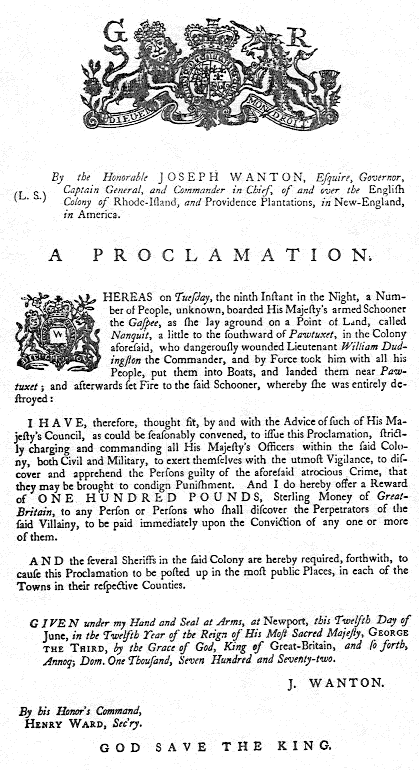
q It was
decided to publicly cooperate in offering a
reward for the perpetrators, but to privately
proclaim ignorance during any ensuing
investigation.
So as to as enhance the image that the
Rhode Island government was cooperative,
Sessions advised Governor Wanton, in Newport, to
immediately post a reward for information on any
of the culprits. See: <http://gaspee.org/Wanton.gif>
q
Representatives of King George III were highly
incensed at the burning of one of His Majesty's
warships and saw the need for definitive action
lest all of the colonies rebel. A proclamation
was made increasing the reward, and an
investigatory commission was impaneled to find
and indict the culprits.
See: <http://gaspee.org/KingGeorgeInstructions.htm>
q This
commission was authorized by the British
government to send any perpetrators found
directly to England on charges of treason. This
attempted circumvention of local American
courts, and of sending persons charged with a
crime across the sea was a singular insulting
threat to the relative independence of all the
colonies.
q Samuel
Adams, the great Bostonian revolutionary, was
asked for advice by Dep. Gov. Sessions and other
local politicians. His response was that he
perceived the threat as being an attempt to
initiate the rollback of the liberal Rhode
Island charter. In his writings, Adams
formulated the idea of starting up the
Committees of Correspondence between the
Colonies to discuss such threats. Based on the
threatened liberties posed by the Gaspee
commission of inquiry, the Virginia legislature
shortly thereafter acted with the formal
establishment of such permanent Committees of
Correspondence. This was, therefore, the start
of unification movement of the Colonies on the
road to independence.
See: http://gaspee.org/SamAdams.html
q John
Allen, an itinerant Baptist preacher, gave a
sermon in Boston that defended the rights of
Colonists to attack the Gaspee,
and accused the British ministers of plotting
the enslavement of the Americans. This
sermon was widely published and became
influential in formulating the ideas of the
necessity of American independence. See http://gaspee.org/Allen.html
q One of the
Gaspee
attackers apparently did not go along willingly.
A biracial indentured servant (ie., slave),
Aaron Briggs, was impressed into the attack by
members of the boat from Bristol as it was on
its way to join the raid. A few
days after the raid Briggs escaped his servitude
on Prudence Island and shortly found himself on
board the HMS Beaver,
a British warship in Narragansett Bay. Under the
threat of being whipped at the yardarm, Briggs
related details of the attack, and named some
individuals, including John Brown, as fellow
raiders. See <http://gaspee.org/Briggs.html>
q Sessions
quickly rounded up witnesses willing to
discredit Briggs and anyone else that would be
of use in identifying any of the culprits. By
creating counter-testimony, Sessions was able to
effectively obfuscate the subsequent
investigation.
See: <http://gaspee.org/SessionsBio.htm>
q
Mistakenly, the British government did not
realize that the attack on the Gaspee
originated in Providence. The Royally-appointed
commission investigating the destruction of the
Gaspee
met in January 1773 in Newport, forty miles to
the South, and was severely hampered by bad
winter weather and the inability of subpoenaed
witnesses to travel.
q Some
people willing to give testimony at the
commission were threatened by other citizens
with bodily harm if they attempted to do so. The
few remaining witnesses examined were chiefly
crewmen from the Gaspee. No one
could recall any names of the culprits; the
attack had taken place on a moonless night, so
identification was nearly impossible.
q In either
event, Chief Justice Stephen Hopkins offered
that the Rhode Island judiciary would not permit
the delivery of any identified attackers to the
British, as it contradicted Rhode Island law
that, based on British law, required local trial
by a jury of peers.
q The
investigatory commission met again in June,
1773, but once again failed to turn up enough
evidence to indict, and closed up their business
frustrated. The inability of the Commission to
gather enough evidence to hand down indictments
was the result of the combined efforts of an
uncooperative Rhode Island populace, judiciary,
and governmental officials. See: <http://gaspee.org/CommissionersReport.htm>
q It is
quite probable that the destruction of the Gaspee
was planned and executed with the help of the
Sons of Liberty well ahead of time. The
Sons were looking to incite the colonial
population against the British, and the Gaspee
made a perfect target. The coincidence of the
timing of the tides necessary to trap the Gaspee,
and of the moonless night necessary to assure
tactical surprise of the attack gives evidence
that this event could only have happened on the
night of June 9th-10th, 1772, and required
preplanning by John Brown and other
conspirators.
Boats sent from both Providence and
Bristol also needed preplanning to coordinate
their attack.
See: < https://allthingsliberty.com/2018/03/conspiracy-destroy-gaspee/
>
q When the
time came to cut ties with the Mother Country,
the American leadership assembled in
Philadelphia in July of 1776 drew up a list of
grievances against King George III. Included in
this document were some injustices that were
directly attributable to the Gaspee
Affair: "He has combined, with
others, to subject us to a jurisdiction foreign
to our Constitution, and unacknowledged by our
laws; giving his assent to their acts of
pretended legislation. .... For depriving us, in
many cases, of the benefit of trial by jury; For
transporting us beyond the seas to be tried for
pretended offenses.” Yes, this
is where we really find the Gaspee;
enshrined within the words of our Declaration of
Independence. < Declaration
of Independence: A Transcription | National
Archives >
Further research
information is available on-line at the Gaspee
Virtual Archives at http://gaspee.org.
|
 Virtual
Archives
Virtual
Archives